
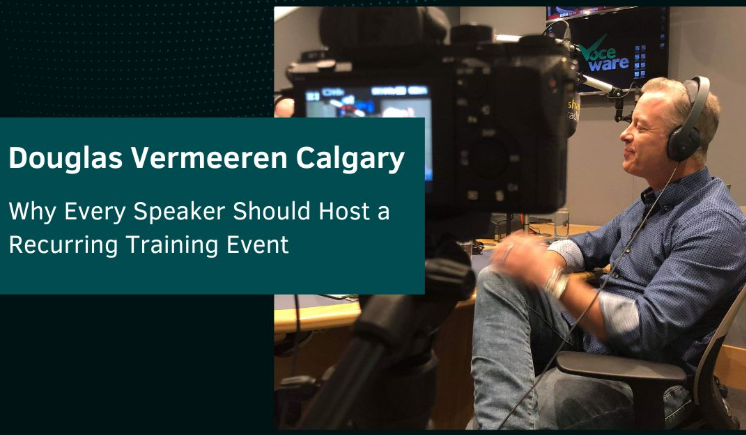
Calgary’s Douglas Vermeeren teaches speakers a simple recurring-event strategy that builds trust, generates referrals, and creates predictable income, one of 75 advanced strategies from the High Profit Speaker program.
Most speakers spend years waiting to be picked. They send pitches to bureaus, follow up with event planners, and hope a past client remembers them the next time budget season rolls around. Douglas Vermeeren, a Calgary-based speaker, author, and coach with more than two decades in the business, thinks that approach has it backwards.
His advice: stop waiting for someone else’s stage. Build your own.
Specifically, host a recurring event ideally monthly where you’re the one running the room instead of hoping to get invited into it.
It’s one of 75 strategies Vermeeren covers in his High Profit Speaker program, and in his experience, it’s one of the few that pays off in more ways than one: it builds trust with people over time, turns your own audience into a referral machine, and gives you a paycheck that doesn’t depend on the next booking coming through.
The Problem With Waiting to Be Discovered
Ask most speakers how they land work and you’ll hear some version of the same story. They’re hoping a conference organizer notices them. They’re hoping a bureau puts them on a roster. They’re hoping a past client mentions their name to someone else. They’re hoping a networking contact makes an introduction.
None of that is a bad strategy exactly, it’s just not their strategy. Every one of those paths puts the decision in someone else’s hands.
A recurring event changes who’s holding the cards. Instead of asking for a stage, you build one, on a schedule you control, in front of an audience you’re actively growing.
The Meetup That Became a Consulting Business
Here’s the kind of story Vermeeren likes to point to. A sales trainer, tired of living and dying by corporate contracts that could vanish without warning, started a monthly gathering, part networking, part short practical training session, same day every month, no exceptions.
He kept the door open two ways: a single ticket for people who wanted to try one session, and an annual membership for people who wanted in on everything. The membership had one perk that ended up doing more work than anything else in his marketing plan: members could bring a guest for free, to any session, anytime.
That’s it. That’s the whole trick. New people started showing up every month as someone else’s plus-one. Some of those guests became members themselves. Some became paying clients. The referrals kept compounding, month after month, and within a couple of years, what started as a small networking meetup had turned into his main source of consulting work, coaching clients, and paid keynotes.
It’s the exact pattern Vermeeren points to when he’s teaching speakers, coaches, and consultants how to stop chasing one-off bookings and start building something that runs on its own momentum.
Nobody Hires You After One Talk
Here’s something most speakers don’t want to admit: people almost never hire a coach or consultant after a single keynote. You might get a standing ovation. You’re not getting a signed contract before you’ve even left the stage.
Real buying decisions of the kind involving coaching packages, consulting retainers, or a paid speaking engagement usually need several touchpoints before someone feels confident enough to write a check. A recurring event gives you exactly that, built in. Every session is another data point in someone’s decision-making process. They watch you handle a live question you didn’t expect. They see you show up consistently, not just perform once. By the third or fourth time they’ve sat in your room, they’ve usually already made up their mind they just haven’t been asked yet.
Turning a Room Full of People Into Actual Income
An event pays you once. A membership pays you every year, whether or not someone shows up to every single session and that difference is the whole point.
The perks that tend to work well:
- Guaranteed seating at every session
- One free guest pass per meeting
- Recordings for anyone who misses a month
- Discounts on bigger workshops or intensives
- A private community space for conversations between events
And you don’t need a packed house for this to work. Twenty or twenty-five committed members, each occasionally bringing a friend, will usually generate more real business than a single event with three hundred people who show up once and never think about you again. Size isn’t the driver here showing up consistently is.
Becoming the First Name People Think Of
Try this test on yourself: if someone in your industry asked a colleague, “Who should I talk to about speaking or coaching in this field?” would your name come up without them having to think about it?
That kind of reputation doesn’t come from one good keynote or a post that did well online. It comes from being in the same room, on the same schedule, over and over.
In a market the size of Calgary tight-knit enough that word of mouth still beats a paid ad, a speaker who shows up reliably every month, without fail, tends to become the default answer to that question simply because so few people bother to be that consistent. It’s the same reputation Vermeeren has built his own name on locally: not one big break, but showing up on repeat.
Two Things Nobody Warns You About
There are a couple of side benefits speakers rarely mention until they’ve tried this themselves.
You never run out of content. Every session produces raw material clips, quotes, testimonials, behind-the-scenes moments enough to fill weeks of newsletters and social posts without ever sitting down to “create content” from scratch.
You get a place to test new material before it matters. Keynote speakers constantly complain they never get to try out a new story before delivering it on a big stage with real money on the line. A monthly event solves that quietly. Try the new bit. Watch what lands and what falls flat. Fix it before a paying client ever hears the final version.
Bringing in outside guests other authors, consultants, podcast hosts, fellow event organizers adds one more layer to this. Each guest shows up with their own audience and their own network, and often returns the favor with an invitation of their own down the road. It’s a collaboration model Vermeeren has pushed for years, because a shared stage grows both people’s audiences at once, not just one.
It’s One Piece, Not the Whole Plan
A recurring event isn’t a cure-all on its own. It’s one piece of a bigger system Vermeeren lays out across his full 75 Advanced Strategies for Getting More Speaking Events which also covers building authority, landing media coverage, developing paid coaching offers, creating signature products, and forming the kind of partnerships that keep referrals flowing in both directions.
Whether someone’s just getting started or already has a full calendar of paid engagements, and whether they’re working out of a major city or a smaller market like Calgary, the underlying idea doesn’t change: the work goes to the person who built the room, not the one still waiting for a seat in somebody else’s.
The Bottom Line
Waiting for a bureau to call isn’t a business model, it’s a hope. Building a recurring event is a business model. It builds trust slowly and honestly, it produces income you can actually count on, it generates referrals without you having to ask for them, and it gives you a stage to rehearse on before the material ever reaches a client who’s paying full price.
As Vermeeren puts it after twenty-plus years of doing this: the stage delivers the message, but it’s the community around it that actually builds the business. Start small. Show up consistently. Let the room do the work advertising never quite manages to.
Frequently Asked Questions
Who is Douglas Vermeeren, and what does he teach speakers?
Douglas Vermeeren is a Calgary-based speaker, author, and coach who teaches practical strategies for building a lasting speaking career instead of chasing individual bookings. His approach leans on recurring events, coaching and consulting offers, multiple income streams, and authority built through consistent community engagement.
Why host a monthly event instead of waiting for speaking bookings?
It lets you build relationships with an audience over time instead of depending entirely on conference organizers or bureaus. Regular events build trust, generate referrals, give you a place to test new material, and create income you can predict from month to month.
How does a monthly training event actually grow a speaking business?
It creates steady visibility. People get familiar with your expertise, start bringing guests, and over time become more likely to hire you for coaching, consulting, or a referral to someone else.
What membership perks actually get people to keep showing up?
Reserved seating, guest passes, recordings for missed sessions, member-only resources, discounts on bigger programs, and a private community space between events all of it built to keep people around long enough to become customers.
Why does this work particularly well in a market like Calgary?
Calgary has a growing base of entrepreneurs and professionals who are actively looking for leadership, sales, and personal development training. In a market that size, word of mouth still moves faster than paid advertising, so consistent monthly events let a local speaker build authority and real relationships quickly.
How long before a monthly event starts producing real results?
It varies, but most speakers start seeing stronger relationships and more referrals within six to twelve months of sticking to a consistent schedule. That’s usually what it takes to build the trust needed for repeat business and new speaking opportunities.


