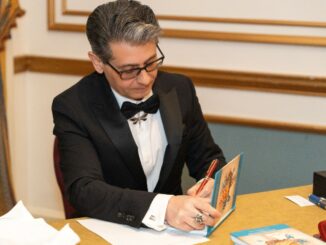

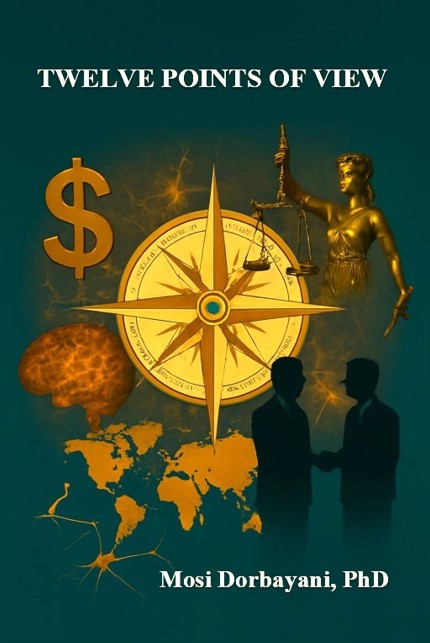
There are moments in scholarship when the world asks us to widen our lens—to step beyond the familiar borders of our disciplines and listen to the deeper conversation unfolding between them. ‘Twelve Points of View’ written by Dr. Mosi Dorbayani was born from such a moment. Each of the twelve briefs is a vantage point, a way of seeing the world not as a collection of isolated problems, but as a living system of interdependent forces. They are written with the strategist’s clarity and the practitioner’s humility—tempered by the understanding that policy, at its core, is about people. On that note, here is our exclusive interview with Dr. Dorbayani, to learn more about his 22nd book and its purpose.
Dr Dorbayani, welcome back to Spotlight Magazine.
MD: Thank you.
What inspired you to bring five disciplines across twelve subject matters?
MD: In truth, the inspiration did not come from the disciplines themselves, but from the human challenges that refuse to stay within disciplinary borders. When I began shaping these twelve briefs, I realized that each subject—whether economic resilience, cultural diplomacy, neuropsychological insight, or legal architecture—was only a partial window into a much larger landscape.
I brought five disciplines together because reality demands it.
Economics explains patterns, but not emotions.
Neuropsychology reveals cognition, but often not culture.
International Law offers structure, but not the lived nuance of policy.
Public Policy provides direction, but not the diplomatic sensitivity required for cooperation.
Cultural Diplomacy bridges people, but needs the grounding of all the others to endure.
These fields are not separate islands; they are currents in the same ocean.
The twelve subjects became my way of demonstrating that when these currents converge, they create clarity—clarity that is strategic, humane, and actionable. I wanted readers to see that durable solutions emerge not from the dominance of one discipline, but from the dialogue between many. In that sense, the book is less a collection of topics and more a conversation among perspectives, each enriching the other.
Many who reviewed your work say the book feels “practical” rather than theoretical. Was that deliberate?
MD: Very much so. Theory is a compass, but people live in the terrain.
In my work—whether in diplomacy, policy, or organizational strategy—I have learned that frameworks must be tempered by practice. A model that cannot survive contact with reality is merely an academic ornament.
These briefs were crafted with sleeves rolled up attitude. They are meant to be used: by leaders, by practitioners, by those who must make decisions in imperfect conditions. If scholarship does not serve humanity, then it has forgotten its purpose.
How do you see interdisciplinary thinking contributing to global leadership today?
MD: Leadership today is no longer about commanding a domain; it is about navigating intersections.
A leader who understands economics but not culture may design policies that fail the moment they meet human emotion. A leader fluent in law but blind to neuropsychology may craft agreements that are technically sound yet socially fragile.
Interdisciplinary thinking is not a luxury—it is a form of responsibility. It allows us to see the whole landscape, not just the terrain beneath our feet. Durable solutions emerge when disciplines converse rather than compete. I did not seek to assemble a catalogue of theories, nor to champion one field over another. Instead, I sought to create a space where Economics could speak to Neuropsychology, where International Law could find resonance with Public Policy, and where Cultural Diplomacy could remind them all that humanity is the ultimate stakeholder.
As an interdisciplinary scholar who has mastered five disciplines across the Social Sciences, Humanities, and Jurisprudence, what did you discover while putting this volume together?
MD: What I discovered, perhaps more profoundly than ever before, is that disciplines are not territories to be defended—they are instruments to be harmonized. When I began weaving these twelve subjects together, I realized that each field carries its own rhythm, its own assumptions, its own way of interpreting the human condition. But when placed in dialogue, something remarkable happens: their limitations begin to dissolve, and their strengths begin to amplify one another.
If readers take only one message from Twelve Points of View, what should it be?
MD: That progress is a collective act of courage.
Courage to think together.
Courage to listen across boundaries.
Courage to recognize that no single discipline, no single method, no single worldview holds the entire truth.
If this book accomplishes anything, I hope it reminds readers that knowledge—when shared with humility and purpose—can become a force for the public good. Our world needs less isolation and more conversation, less certainty and more curiosity. That is where transformation begins.
Dr Dorbayani, thank you for attending this, and good luck with your scholarly endeavours.
MD: My pleasure. Thank you for having me.
Related Link:
Twelve Points of View is available from: Chapters-Indigo, Canada, Barnes & Noble, USA; and Amazon Books, worldwide. https://www.amazon.ca/stores/Mosi-Dorbayani/author/B06XHSGN6M
Previously on Spotlight Magazine: https://spotlightmagazine.ca/2025/03/15/culture-neuroscience-a-fascinating-field-benefiting-academia-and-policymakers/