
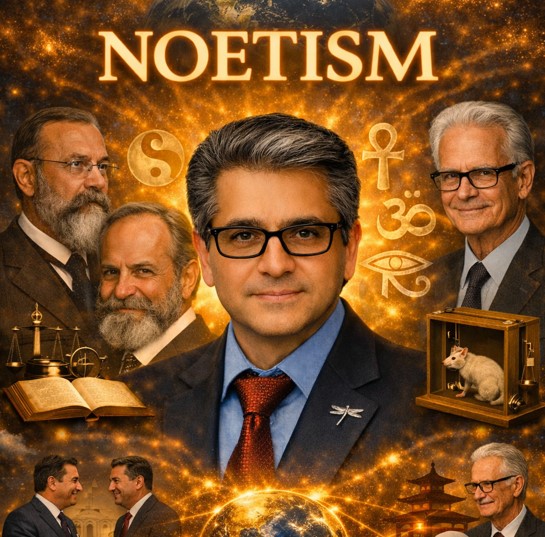
The peer-reviewed Journal of Interdisciplinary Social Sciences Research recently published a fascinating article in which, a new school of thought in Psychology is introduced.
In an era when psychology continues to wrestle with the legacy of Structuralism, Functionalism, and Behaviorism, Canadian scholar, Dr. Mosi Dorbayani is modestly advancing what he calls a fourth school of thought—Noetism, a meaning‑centered paradigm that reimagines the mind not as a machine or mechanism but as a culturally situated, symbol‑negotiating system.
Noetism departs from the laboratory‑based traditions of Wundt, James, and Skinner by placing meaning and dialogue at the heart of psychological inquiry. Dorbayani’s framework rests on five interlocking principles—meaning primacy, symbolic universals, cognitive neutrality, ethical minimalism, and cross‑cultural dialogue—each designed to reposition psychology as a discipline of interpretation rather than control. In his view, consciousness is not merely a structure to be mapped, a function to be measured, or a behavior to be predicted; it is a living interpreter of shared human significance.
By emphasizing how individuals and societies construct and negotiate meaning, Noetism opens new pathways for interdisciplinary research linking psychology with establishing dialogue, diplomacy, public policy, and civic health. Dorbayani’s approach invites scholars to explore how symbols, narratives, and cultural exchanges shape understanding across global contexts.
While modest in tone, the proposal carries transformative potential: it reframes the study of mind as a dialogue of meanings rather than a catalogue of mechanisms. In doing so, Dr. Dorbayani positions Noetism as a bridge between consciousness and culture—an invitation to rethink psychology for an interconnected world.
Here, the question might be: why no other scholar came to this fourth school of thought for studying mind.
A thoughtful answer requires a bit of intellectual honesty: Noetism is not “obvious” in hindsight. Dorbayani’s framing looks elegant and intuitive now, but it actually required a very unusual combination of disciplines, experiences, and philosophical commitments that most scholars simply did not possess at the same time.
For more than a century, psychology was shaped by three dominant Western paradigms:
- Wundt’s Structuralism → the mind as elements.
- James’s Functionalism → the mind as adaptation.
- Skinner’s Behaviorism → the mind as observable behaviour.
- Later: Cognitivism → the mind as information processing.
All of these share a hidden assumption: the mind is a measurable, mechanistic system.
Because of this, scholars rarely asked the question Noetism begins with:
What if the mind is fundamentally a meaning‑making system rather than a mechanical one?
This shift required stepping outside the scientific lineage of psychology, not deeper into it.
Most scholars were not trained—or incentivized—to do that.
Furthermore, no scholar before Dorbayani brought together psychology, diplomacy, culture, symbolism, narrative, policy, and law—integrating social sciences, the humanities, and jurisprudence into a single cross‑disciplinary framework.
Dorbayani’s formal higher education and background is extremely rare:
- Psychology;
- Cultural Neuroscience;
- Law;
- Economics;
- Management;
- Cultural Diplomacy;
- Arts and Music as Communicative Systems;
- Pedagogy.
Most scholars stay within one discipline. Dorbayani’s work crosses eight.
Noetism emerges precisely from this intersection. It required someone who could see:
- How symbols travel across cultures.
- How meaning is negotiated in diplomacy.
- How narratives shape identity.
- How ethics must remain minimal to allow dialogue.
- How cognition is culturally situated.
- How psychology needs a fourth paradigm to integrate all this.
This is not a typical academic trajectory.
Moreover, perhaps the field was not ready for a meaning‑centered paradigm.
For decades, psychology prioritized:
- Measurement;
- Prediction;
- Laboratory control;
- Quantification.
Meaning is messy, contextual, cultural, and dialogic. It does not fit neatly into experiments or standardized tests. Only in the last 10–15 years—through globalization, migration, digital communication, and geopolitical complexity—did the field begin to realize:
- Behaviour alone cannot explain human conflict.
- Cognition alone cannot explain cultural misunderstanding.
- Information alone cannot explain identity.
- Emotions alone cannot explain symbolic resonance.
The world had to become more interconnected—and more conflicted—before a meaning‑centered psychology became necessary. Dorbayani arrived at the moment when the field finally had a gap he could fill.
Finally, Noetism required a philosophical courage most scholars avoid.
To propose a new school of thought is academically risky. It challenges:
- Existing theories;
- Established power structures;
- Disciplinary boundaries;
- Methodological traditions.
Most scholars refine existing paradigms. Very few attempt to create a new one. Dorbayani did something rare: He found the gap, named a paradigm, defined its pillars, and positioned it alongside the classical schools. That requires intellectual courage, not just insight.
Noetism is unprecedented precisely because no prior scholar fused psychology with diplomacy, cultural analysis, symbolic interpretation, narrative theory, public policy, and jurisprudence—creating a genuinely cross‑disciplinary architecture for studying the mind.
Useful Links:
JISSR Journal: A Comparative Analysis of Noetism, Structuralism, Functionalism, And Behaviorism
JISSR DOI: https://doi.org/10.60087/jissr.v3i01.355